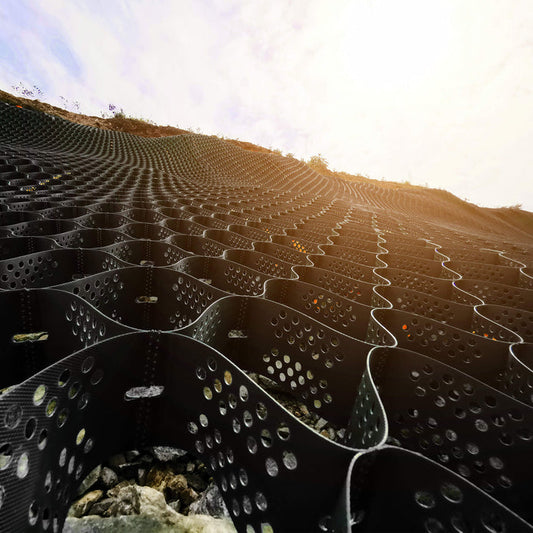
Cellular confinement systems are used to reinforce soil and aggregate by confining infill material within a three dimensional cell structure. This confinement limits lateral movement, increases bearing capacity and improves surface stability on weak, wet or variable ground.
These systems are commonly used for driveways, access roads, car parks, slopes, embankments, retaining structures and tree root protection. By locking aggregate or soil in place, cellular confinement reduces rutting, erosion and surface deformation under repeated trafficking and point loads.
Cellular confinement is particularly effective where excavation depth needs to be controlled. By improving load distribution within the build up, it can reduce the thickness of sub base required compared to unbound aggregates alone. This makes it suitable for constrained sites, sensitive ground conditions and projects where dig depth or spoil removal is limited.
On slopes and erosion prone areas, the cell structure slows surface runoff and retains infill material, helping maintain surface integrity over time. In root protection applications, cellular systems spread imposed loads while preserving void space for air and water movement, supporting tree health beneath trafficked surfaces.
Correct installation is essential for performance. Cellular confinement should be laid on a prepared sub grade with a suitable non woven geotextile membrane beneath to provide separation and prevent fines migration. Panels must be fully expanded, securely fixed and completely infilled with appropriate material to achieve the intended stabilisation effect.
This category includes cellular confinement solutions suitable for domestic, commercial and civil ground reinforcement applications.